
Relative Pronouns
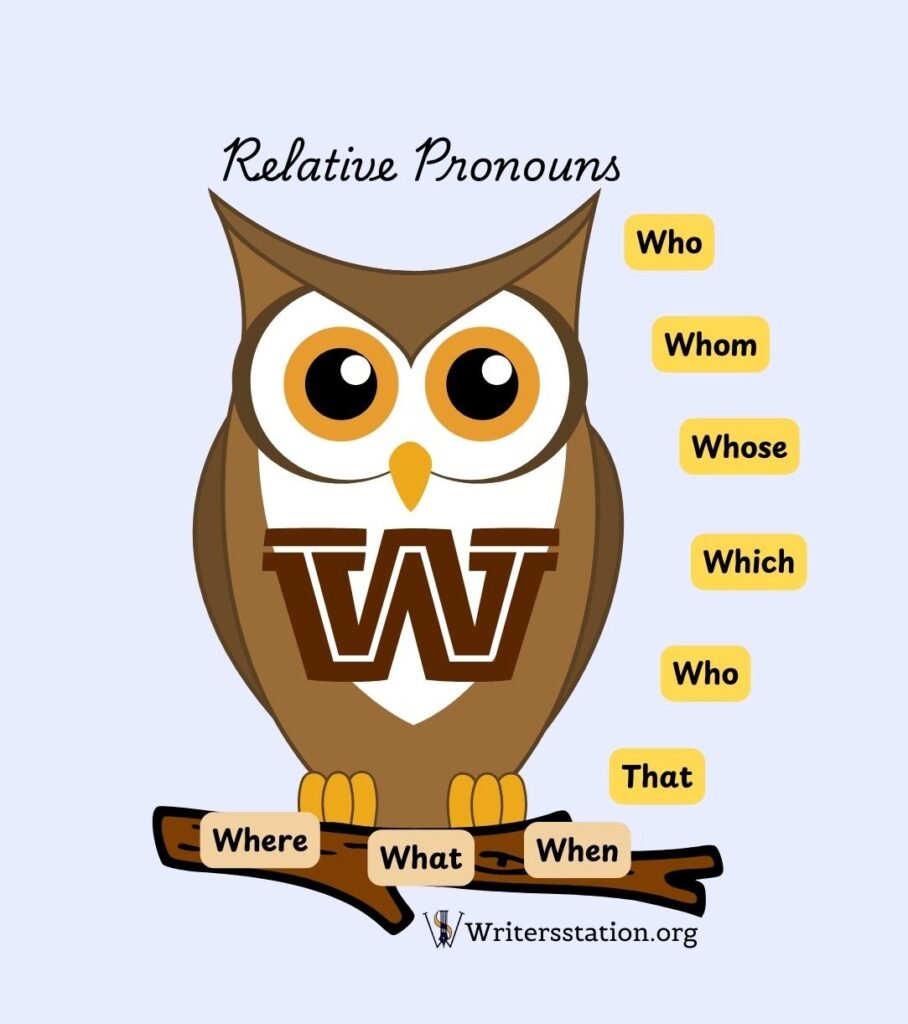
Relative pronouns introduce dependent clauses and connect them to an independent clause. They allow you to provide more information to the readers about the noun or pronoun. The most common relative pronouns are: who, whom, whose, which, and that. However, words like “where”, “when”, and “what” can sometimes be used as relative pronouns.
Relative pronouns modify a word, phrase, or idea in the main clause. There are two types of relative clauses: restrictive and nonrestrictive.
Restrictive clauses are essential to the sentence, so they are not separated from the sentence with commas. Generally, the relative pronoun, “that” is used for restrictive clauses.
Non-restrictive clauses are not essential to the sentence, and are mostly separated from the main clause using commas. Generally, “which” is the preferred relative pronoun for non-restrictive clauses over “that”,
- Who: (E.g. The girl who cried wolf learned her lesson.)
- Whose: “Whose” is used to show possession, connecting a clause to a noun that it possesses. (E.g. Karen, whose essay placed first in the country, spoke at the conference.)
- Whom: “Whom” is not used very often in casual English or while speaking. However, in formal writing, Whom is used when the pronoun is an object of a verb or preposition. In other words, use “whom” when the pronoun is receiving the action. (E.g. The buyer whom the seller gave discount to was satisfied about the deal.)
- Which: “Which” is typically used in non-restrictive relative clauses that provide non-essential information about the antecedent. (E.g. The building, which was built last year, is abandoned.)
- That: “That” can only be used in restrictive clauses. In some cases, it can be replaced by “who”, or “which” in informal English. (E.g. The building that had a faulty in its foundation collapsed within a year.)
- When: (E.g. I remember the day when I found out about the secret.)
- What: (E.g. I did not hear what they said.)
- Where: (E.g. The city where the movie was filmed is San Diego.)
Relative Pronouns Worksheet #1
[Grades 4-6] Relative Pronouns #1 Worksheet with Answers
[Grades 4-6] Relative Pronouns #1 Worksheet Only
[Grades 4-6] Relative Pronouns #1 Answers Only
Powered By EmbedPress
Powered By EmbedPress
Powered By EmbedPress
Relative Pronouns Worksheet #2
[Grades 4-6] Relative Pronouns #2 Worksheet with Answers
[Grades 4-6] Relative Pronouns #2 Worksheet Only
[Grades 4-6] Relative Pronouns #2 Answers Only
Powered By EmbedPress
Powered By EmbedPress
Powered By EmbedPress
Relative Pronouns Worksheet #3
[Grades 4-6] Relative Pronouns #3 Worksheet with Answers
[Grades 4-6] Relative Pronouns #3 Worksheet Only
[Grades 4-6] Relative Pronouns #3 Answers Only
Powered By EmbedPress
Powered By EmbedPress
Powered By EmbedPress
Relative Pronouns Worksheet #4
[Grades 4-6] Relative Pronouns #4 Worksheet with Answers
[Grades 4-6] Relative Pronouns #4 Worksheet Only
[Grades 4-6] Relative Pronouns #4 Answers Only
Powered By EmbedPress
Powered By EmbedPress
Powered By EmbedPress